Disclaimer: my references to the writings of other people–both Indigenous and Non-Indigenous–do not in any way imply they share my views on this matter. The opinions expressed here are my own and do not necessarily represent those of my family, friends or associates.
Introduction
Honorary Dene Chief Cece Hodgson McCauley (1922-2018), Cree writer and musician Tomson Highway and B.C. First Nations Chief Aaron Pete were/are the three Indigenous risk-takers I will be telling you about in this post.
Cece Hodgson McCauley (1922-2018)
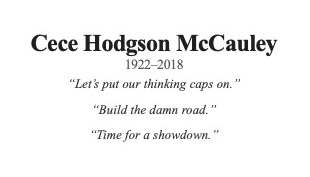
I first became aware of Cece Hodgson McCauley when I was living in Yellowknife, Northwest Territories, May 1975 to October 1976 and November 1983 to April 1987. She was a Metis woman who was born on a trapline at Canyon Creek, which is between Norman Wells and Tulita (Fort Norman) in the Northwest Territories. After her mother died when she was six, she was sent to a residential school (called a “Convent”) in Fort Providence for 10 years.
Despite her challenging start in life, she accomplished much. She was the founding chief of the Inuvik Dene Band–the first woman chief in the Northwest Territories–and was made an honorary chief for life. In addition, she was the former president of the Norman Wells Land Corporation and founder of Women Warriors of the Sahtu. The Sahtu is centrally located in the Northwest Territories where the North Slavey live. Tulita is one of five communities in this region.
Hodgson McCauley married James (Mac) McCauley from Fort Norman and they had a son Herbert. They later divorced, but she considered him to be the love of her life.
During the time I was in Yellowknife, Hodgson McCauley regularly wrote letters to the editor and then on May 24, 1985, commenced her column called “Northern Notes.” She handwrote her columns and faxed them in. Her byline was initially Cece Hodgson then Cece McCauley and later Cece Hodgson McCauley. Some sources show her surname as hyphenated but it was not. 1
When I was in Yellowknife in the 1980s, I usually picked up News/North every week and I still have some of her printed columns from that period. I subscribed for a few years after I left, so I also have some of her writings up until 1991. 2 During the 2015 to 2020 period, I had a digital subscription to Northern News Services Online which included her column. On March 5, 2018, she submitted her last dispatch and passed away March 11, 2018 at the age of 95. For a couple of years after her death there were quite a few articles discussing how much she contributed to the north.
What impressed me the most about her was that, even as political correctness (as it was commonly referred to back in the late 1980s/early 1990s) increasingly took hold of the Canadian mainstream, she swam against the current, by regularly espousing whatever was on her mind. Nothing escaped her penetrating gaze when it came to calling out what she thought needed improvement.
She would get angry with Non-Indigenous government leaders in one column for staying in the North until they were eligible for a pension and then moving to warmer climes. In a later column, she would chew out the Dene and Metis leaders for caving into the government’s divide and conquer games and not remaining unified. So, she was constantly lighting fires under all sides to get people to act responsibly rather than sitting on their “behinds.” As Dene columnist Roy Erasmus observed, she may not have always checked her facts, but “agree or not, you had to respect her tenacity.”
As the residential schools’ issue became increasingly pronounced, she fearlessly maintained that the 10 years she spent at the “Convent” in Fort Providence were the best years of her life. She acknowledged that some of the nuns were overly strict, but she nonetheless learned many valuable skills, such as knitting, beading, quillwork, cooking and baking. Her positive views of the schools and her other controversial pronouncements got her on the wrong side of numerous people. There were quite a few letters to the editor and news articles taking issue with what she said in her columns but she remained undeterred. Around 2015 to 2018, she even included her home phone number in Norman Wells in “Northern Notes” so people could contact her with their opinions. I phoned her in May 2016 and January 2018 to tell her I had written about her on my blog. For instance, in September 2015, I mentioned some of her columns in my critique of the Truth and Reconcilliation Commission final report executive summary. (You can find this post by clicking on the September 2015 monthly archives on the right side of this blog.)
I was very happy when in 2017, she was honoured with the Indspire Award in recognition of her contributions to political discourse. During her acceptance speech, she joked that “I don’t think the government likes me very much, but I don’t care about that,” which her daughter-in-law said “brought the house down.”
Besides her outspokenness regarding political matters, she was also an advocate for the completion of the Mackenzie Valley Highway up to the Sahtu region where she lived. In June 2018, the federal and territorial governments invested $140 million to commence the work in 2021 over two summers. However, little progress was made due to environmental assessments and funding issues. Then in early 2026, Prime Minister Mark Carney announced $35 billion for infrastructure improvements in the Northwest Territories which would include completing the highway to Inuvik by late 2027 or early 2028. The reason for the renewed interest is the federal government’s Arctic sovereignty, national defence and critical minerals strategies. But community consultations and environmental assessments still have to be completed.
As Dene columnist Roy Erasmus noted in his May 5, 2026 Northern News Services column, Hodgson McCauley must be smiling and cheering because she was a “champion of the highway for decades.” Let us hope her dream will finally come to fruition.
As you can see, Hodgson McCauley took risks by encouraging dialogue through her published writings. She also promoted a more in-depth discussion about the residential schools–a debate that is ongoing to this day.
Tomson Highway
The second Indigenous risk-taker I want to highlight is Tomson Highway, whom I have known since 1978. We met when he was studying and working in London, Ontario. In 1975, he obtained his Bachelor of Arts (piano performance, major) and the following year earned the equivalent of a Bachelor of Arts (English major) both from the University of Western Ontario in London.
On November 21, 2021, I published a blog post about him that discussed his memoir Permanent astonishment: growing up Cree in the land of snow and sky (2021). I also mentioned his work on the Festival of Native Music ’78 and at the Native Peoples Resource Centre in London. In addition, there are photos of Highway, his partner Raymond Lalonde, and me having dinner at a London restaurant in August 2021. You can find this post by clicking on the November 2021 monthly archives on the right side of this blog.
The Canadian Encyclopedia describes Highway as “one of the most prominent and influential Indigenous writers in Canada.” in 1998, Macleans Magazine included him in their list of the 100 most important people in Canadian history. His honours include being an Officer of the Order of Canada and the recipient of the Governor General’s Lifetime Artistic Achievement Award for the Performing Arts. He has received numerous accolades for his published works that include plays, a novel, a memoir and children’s books.
In addition, he is a trained classical pianist who has written and produced original compositions, including in his Cree language. The University of Western Ontario is one of 11 universities across Canada that have awarded him honorary doctorates.
He had both positive and negative experiences at the residential school he attended for nine years. Until around 2001, he dwelt on the negative aspects. But he then said he had “exhausted his rage” and decided to celebrate his life instead. The trauma of his residential school years had to come out, which it did in his Kiss of the Fur Queen (1998) novel and in published writings and interviews. But he concluded it was better to forge an understanding across the cultural divide. He stresses the importance of acknowledging the positive aspects of Indigenous and Non-Indigenous relations, instead of dwelling solely on the negative.
Although he did not change his stance on the residential schools until around 2001, he was sympathetic to those working with Indigenous people in the theatre before that. In his “Native theatre centre stage” article, which was published by the Toronto-based Aboriginal Voices around 1995, he said Native theatre projects had recently been successful because they were community efforts organized with “kindness, generosity, love, patience and mutual support.” The Native theatre movement was still in its infancy and people needed to maintain their humility. Native people had achieved these heights with the help of many supporters, the majority of whom were Non-Native. He said these “kind and generous people” needed to be thanked “every day of our lives,” regardless of skin colour.
Highway’s support for Non-Indigenous people in the above article meant so much to me that I made a copy of it and taped it to the side of my bookshelf. His point of view was very uncommon at the time and is still a rarity among many Indigenous activitists.
In January 2023, I had a great phone conversation with Highway, during which he elaborated on many of the themes that were briefly discussed in my November 2021 post about him.
Since I am a University of Western Ontario grad (Master of Library and Information Science) like him, I was particularly interested in what he had to say about our alma mater, along with his praise for his London experiences. He said of his time in London:
“I really loved it. I remember those years as a golden time in my life. I think about it a lot. I thank some of those professors who were absolutely fantastic.”
Tomson Highway
One of the academics who influenced him was English professor James Crerar Reaney (1926-2008). Reaney adapted a 1832 novel written by Major John Richardson (1796-1852) into the play Wacousta! which is set in 1763. While at Western, Highway was the Cree
“coach” for Reaney’s Wacousta! play workshop. The drama takes place in English, French and Odawa, but Reaney substituted Cree for the Odawa, courtesy of Highway. Some of the people participating in the production were enthusiastic about Highway teaching them Cree.
(You can find out more information about HIghway’s role in this workshop by navigating to the jamesreaney.com website, and then to the June 30, 2025 post entitled “James Reaney’s 1976 Wacousta Workshops and Tomson Highway.”)
Although I was not involved with the Wacousta! workshops, I certainly knew Reaney. This was because my mother and he collaborated on several creative projects that are discussed elsewhere on this blog.
Highway explained how cultural tensions developed between Indigenous and Non-Indigenous people in his 2022 Massey Lecture. The lecture was entitled: Laughing with the trickster: on sex, death and accordions. I own a copy of the text for it, which was published that same year.
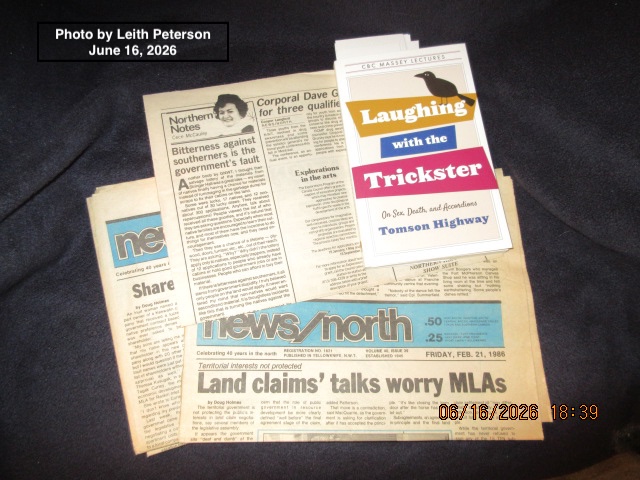
In the photo below you can see the front cover of Highway’s book, along with Hodgson McCauley’s column in News/North, August 14, 1989 (top of column only), along with the News/North front cover, February 21, 1986.
Highway said that Cree was the “lingua franca” in his household when he was growing up in the 1950s in “Old Brochet” Manitoba. That was why he kept his language. In the summer of 1973, electricity arrived and “its most subversive offspring television.” After that Native people in his community started to lose their language, their sense of humour and their culture.
In Laughing with the trickster, Highway also said that the Catholic teachings were preoccupied with the idea that life entails suffering. He believes instead that people should laugh every day and celebrate what life has to offer. He is upset that the church led him and other Indigenous people to believe that only if they followed Christian beliefs, they would go to heaven, which was not only cruel, but deeply harmful spiritually.
The Catholic church not recognizing divorce meant Native couples stayed together even when their relationships were dysfunctional. In traditional Cree societies, divorce was acceptable and meant, in his language, to throw each other in the garbage.
In Indigenous mythology, a person’s remains disintegrated into the earth and in five or six generations, reappear as a blade of grass, a leaf on a tree or a ray of sunshine. Over time the physical self can evolve from inanimate back to animate, e.g., as another human being in the next generation. There is no heaven or hell, just the garden that Indigenous people were put on this earth to care for.
Indigenous pantheism considers all of creation to be “divine energy” so there is no separation of nature and humankind, as there is in the monotheistic, male-dominated Christian mythology. Highway believes pantheism leads to more appreciation of Mother Nature, which can result in fewer problems with climate change. I am a Christian who does not share some of Highway’s pantheistic views, but I accept the fact that he feels strongly about them.
I have had some positive experiences with Catholics, such as Rene Fumoleau (1926-2019) an Oblate priest who devoted a major part of his life to supporting the Dene in the Northwest Territories. When I worked at the Dene-Metis Negotiations Secretariat out of the Dene Nation Library, November 1983 to April 1987, Fumoleau came down regularly to see me and the rest of the library staff. He was very supportive and encouraging of the work I was doing. He played a crucial role in helping the Dene with their land claims. In addition, he documented the Dene story in more than 15,000 images which are now in the possession of the Northwest Territories Archives.
I told Highway that although I was deeply saddened by his negative experiences with the Catholic church, I retained positive memories of Catholics such as Fumoleau. In Highway and my January 2023 phone conversation, he responded that:
“[T]here are many lovely Catholics who had a good influence on me, including the staff at the residential school I attended for nine years in Le Pas, Manitoba. And there were priests and nuns who taught at the school who were lovely, lovely people. People tend to trash the whole community because of one rotten apple in the barrel. . .It’s not so much the Catholic church as it is monotheism, the structure [that I object to].”
Tomson Highway
My personal preference is that Canadian society will strive for a way forward that recognizes the positive aspects of both Indigenous and Christian beliefs. The Christian faith has been a big part of my family history on both sides. Although I do not belong to any Christian denomination, I still try to adhere to Christian tenets, such as the Ten Commandments.
Highway was harmed by some aspects of Non-Indigenous society, but he has refused to let these drawbacks dictate how he lives his life. Like he said on his website: tomsonhighway.ca, he has learned to stop complaining and celebrate his life.
Aaron Pete
I first became aware of Aaron Pete when I read Douglas Todd’s article about him, that was published in both the Vancouver Sun and the National Post in December 2025. I learned from Todd’s article and subsequent ones by Pete and others that his grandmother had become an alcoholic due to the trauma of attending the St. Mary’s Indian Residential School in Mission, British Columbia. His mother developed fetal alcohol syndrome because of this, but fortunately Pete has not been affected by his mother’s condition.
A Non-Indigenous Catholic nurse named Dorothy Kennett took in his mother and him. He refers to Kennett, now deceased, as his non-biological grandmother and credits her for helping to turn his mother’s and his lives around.
After Pete completed his law degree in May 2022, he worked as a Native court worker and the host of the “Bigger Than Me” podcast. In September 2022, he became a councillor in his Chawathil First Nation community in British Columbia. He was officially sworn in as chief on July 18, 2025.
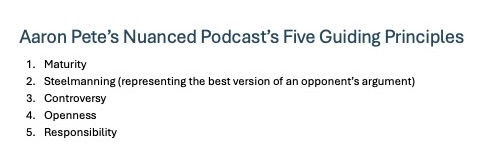
In June 2025, he rebranded his podcast “Nuanced,” to coincide with the 200th episode. The five guiding principles of Nuanced are maturity, steelmanning (representing the best version of an opponent’s argument), controversy, openness and responsibilty.
He also has a “Nuanced” Substack where he provides further commentary on many of the interviews he has given.
I have watched quite a few episodes of the Nuanced podcasts plus the accompanying Substacks. I think Pete does a good job of following his five guiding principles.
Pete believes that individuals should make decisions after studying all sides of the story. He listens to not only those who share his concerns about Indigenous well-being, but also to those who argue that Indigenous peoples should not have special status and should instead participate In Canada’s economy as equals. He stresses that many Indigenous communities face economic hardships and must become self-sustaining before they can participate fully.
His approach is a breath of fresh air compared to many Indigenous activists who insist that only those who kowtow to all Native demands and who believe that Canada is on “stolen land” can be heard.
Below are the podcasts and accompanying Substacks that I found the most interesting.
Interview with Jonathan Kay
“The Shocking Impact of Political Correctness” – Pete’s conversation with Jonathan Kay, June 7, 2024. This was when Pete’s podcasts were still under the “Bigger Than Me” moniker. The Substack for this is entitled “Three Surprising Insights on Political Correctness,” June 8, 2024.
Kay is the Toronto editor for Quillette, an online magazine based in Australia. He is also a podcaster and an advisor to the Foundation Against Intolerance and Racism. In addition, he has had several books published, including Among the Truthers.
I have often agreed with Jonathan Kay over the years when it comes to Indigenous issues, so I was particularly interested in hearing Pete’s interview with him. They both agreed that constructive conversations have been stifled by what Kay referred to as a “pious solemnity” which dwells on performative gestures such as land acknowledgements, rather than ways that Indigenous peoples’ lives can be improved constructively.
Pete said he had reviewed all the chapters in Grave Error: how the media misled us (and the truth about residential schools). This book was published by True North and Dorchester Books in 2023 and sold more than 10,000 copies. It is co-edited by C.P. Champion and Tom Flanagan, who have been outspoken about problems with the standard Indigenous narrative. This narrative places most of the blame for Indigenous dysfunction on colonialism and Western civilization. Contributors to Grave Error include academics, retired legal experts and political commentators.
Kay supplied two chapters to the above book that were originally published in Quillette. Pete said he had read essays by other Grave Error contributors but Kay’s chapters stood out for him because Kay concentrated on factual evidence.
Interview with Nigel Biggar
“Was Colonialism all Bad?,” Bigger Than Me, June 20, 2024 and the Substack of the same name, June 21, 2024. Biggar is a retired ethics professor from the University of Oxford in England. He has written about the “moral complexities” of colonialism. His book Colonialism: a moral reckoning, published by Harper Collins, sold 60,000 copies and became a commercial success.
Towards the end of the interview, Pete thanked Biggar for writing the book, noting it was published at a time when Biggar’s views were unpopular. Although Pete took issue with some of what Biggar said, e.g. regarding Canada’s first prime minister John A Macdonald, he thought the book was still worth reading. Biggar said that Pete was the first First Nations Canadian he had spoken with about his book, and that he had been nervous about coming on the show. But he said he was glad he did and that it was a model for others to follow.
Tim Thielmann Interview
“Tim Thielmann and Aaron Pete DEBATE whether Canada should end reconciliation,” Nuanced, May 8, 2026. The Substack for this published on the same date is called “Why I chose to debate Tim Thielmann.”
Thielmann is a lawyer living in Victoria, British Columbia who represented First Nations on a variety of government/economic agreements for about 15 years. However, he no longer works in this area and is now of the view that Indigenous people should not have any special rights.
Thielmann contends that the overall benefits of colonialism far outweighed any detriments and was not swayed by Pete pointing out the negative aspects of colonialism and the residential schools. I sometimes found Thielmann’s position quite rigid and was impressed with how Pete kept his cool.
Billy Morin Interview
“Why Billy Morin Refused to Cross the Floor to the Liberals,” Nuanced, May 25, 2026. The Substack name for this interview is “Conservative MP Billy Morin on Mark Carney, Pierre Poilievre and Separation,” and was published that same day.
Billy Morin is the federal Conservative representative for Edmonton Northwest. Before that he was chief of the Enoch Cree Nation in Alberta during the 2015 to 2022 period. He believes that Indigenous people should be accountable for the government monies they receive. In fact, when he was chief, he took action against one of his own relative’s misuse of funds. He helped to steer his nation out of an $8 million deficit.
Pete asked Morin how the Kamloops residential school narrative and reconciliation should best be handled. Morin said this topic was difficult to address because of the strong feelings some former students have regarding abuse that occurred at some residential schools. However, he said the $12 million the band got for investigating whether children’s graves were in the former apple orchard needed to be dealt with because the money was provided by the government. He said that was an example of why he was in favour of former Conservative prime minister Stephen Harper’s First Nations Financial Transparency Act (FNTA) which former Liberal prime minister Justin Trudeau stopped implementing when he took office in 2015. However, the FNTA remains on the books and has never been formally repealed by Parliament. Morin thinks the FNTA should be reinforced.
Morin is a big supporter of Conservative leader Pierre Poilievre. I am generally in favour of Poilievre’s approach towards dealing with Indigenous issues, so was glad to hear Morin felt the same way.
The bulk of the interview was about why Morin refused to cross the floor to the Liberals. I agree with Morin’s decision on this. I think the constituents who elected him did so for a reason which should be honoured.
Interview with Mark Milke
“The Victim Cult: Mark Milke on Reconciliation, Identity and Responsibility,” Nuanced, June 4, 2026. Substack: “The Problem with the Victim Mentality,” June 13, 2026.
Mark Milke is the founder and president of the Aristotle Foundation for Public Policy which advocates for freedom, democracy and civilization. He was born and raised in Kelowna, British Columbia and now lives in Calgary, Alberta.
His book: The victim cult: how the culture of blame hurts everyone and wrecks civilizations (2019) is one that I reference regularly. This book was the focus of Pete’s interview with Milke.
I have followed Milke’s writings for some time so many of the themes he explored with Pete are familiar to me. I am particularly interested in Milke’s concerns about how unchecked power can lead to abuse.
Although Milke acknowledged that some Indigenous reserves are successful, he noted it was often because of a skilled chief who knew how to harness economic and other opportunities. But if the chief departed, the fortunes of the reserve could nosedive.
Milke is in favour of a return to classical liberal values, such as individual accountability, merit, free expression, and objective truth. He believes that moving past a culture of blame is necessary for both individual fulfillment and national unity
Conclusion re Aaron Pete
Although I do not always agree with Pete, I think his willingness to be open to different points of view is fantastic. It is great that his podcasts and Substack have many Indigenous and Non-Indigenous followers. Most Indigenous commentators stick to the “it’s all the White man’s fault” narrative, which does not address all the variables. Pete’s approach is a very welcome change. I hope he inspires other Indigenous leaders to do the same.
Conclusion re Cece Hodgson McCauley, Tomson Highway and Aaron Pete
All three of these risk-takers discussed/discuss the impact of residential schools. Hodgson McCauley and Pete highlight economic development issues, while Highway focusses on Indigenous cultural revitalization. Their philosophies are worth closer examination. I hope this post will encourage you to investigate their writings more thoroughly.
Endnotes
1 I mistakenly hyphenated Hodgson McCauley’s name in my September 7, 2015, May 25, 2016 and June 2, 2019 posts. However, I will not hyphenate her surname from this post onwards.
2 Some of my printed News/North issues have been deposited as part of the “Peterson Family Fonds” at Archives and Special Collections at the University of Western Ontario.
Bibliography
Other bibliographic references to Cece Hodgson McCauley can be found in the following posts: September 7, 2015, May 25, 2016 and June 2, 2019. You can find these in the monthly archives on the right side of my blog.
Other bibliographic references to Tomson Highway can found in the following posts: September 7, 2015, November 6, 2015 and November 21, 2021. These can be located in the monthly archives on the right side of my blog.
Baltruschat, D. (2004). Television and Canada’s Aboriginal communities. Canadian Journal of Communications, 47-59.
Calabretta, T. (2018, March 17). Storied careers. The Ryerson School of Journalism.
Edwards, T. (2018, March 17). ‘I did very well, didn’t I?’ Northern News Services Online.
Erasmus, R. (2018, March 17). When the heart says no: Cece Hodgson McCauley wanted unity. Northern News Services Online.
Erasmus, R. (2026, May 5). When the heart says no: Mark Carney good for the NWT. Northern News Services Online.
Gessell, P. (2022, October). Laughing with the trickster. Fifty-Five Plus.
Highway, T. ([1995]). Native theatre centre stage. Aboriginal Voices, p. 50.
Highway, T. (2022). Laughing with the trickster: on sex, death and accordions. Toronto: Anansi.
Highway, T. (2026, June 14). Speaking and performing – Tomson Highway. Retrieved from Tomson Highway: tomsonhighway.ca/speaking-performing.
Hodgson McCauley, C. (2018, March 12). Cece Hodgson McCauley (1922-2018). [Obituary.]
Malbeuf, J. (2018, March 12). Cece Hodgson-McCauley remembered as fearless, tireless and a little like Trump. Retrieved from CBC News.
Martin, S. (2001, October 3). Finding joy beyond the rage. Globe and Mail.
McFadden, J. (2018, June 27). Governments announce $140M for Mackenzie Valley Highway. CKLB 1019.
Metro Morning, CBC Radio. (2022, September 23). Celebrated author and playwright Tomson Highway on why laughter is our salvation.
Milke, M. (2019). The victim cult: how the culture of blame hurts everyone and wrecks civilizations. Thomas & Black
Minore, J.B. & Hill, M.E., (1990-1991). Native language broadcasting: an experiment in empowerment. Canadian Journal of Native Studies, 97-119.
Northern News Services Online. (2018, March 12). Cece Hodgson-McCauley.
Northern News Services Online. (2016, February 8). Putting our thinking caps on!
Pete, A. (2025, November 6). Aaron Pete: Criminalizing ‘downplaying’ residential schools won’t help anyone. National Post.
Pete, A. (2026, June 3). Aaron Pete: Criminalizing residential school denialism won’t help reconciliation. National Post.
Todd, D. (2025, December 20). Meet B.C. Chief Aaron Pete: one of the hottest new voices in Canada. Vancouver Sun.