Sometimes things just work out. That is what happened between my mother Jay Peterson (1920-1976) of London, Ontario, Canada, and Jessica Hill from the Oneida of the Thames settlement in Southwestern Ontario. They met in the mid-1960s at a high school in London, and forged a lifelong friendship based on the arts.
Hill’s Indigenous community is about a 30-minute drive from London. It is not a reserve, but a settlement. This is because the Oneidas purchased their new hunting grounds in 1840 in Southwestern Ontario, after they migrated from New York State. In other words, their land is not allotted or granted by the government.
When Hill was born at Oneida in 1949, there was no indoor plumbing–that did not arrive until 1964 to 1965. Since 1879, the community has held annual fall fair exhibitions (also known as fall fairs) which showcase local products, creations and talents.
The Wolf, Bear and Turtle Clans make up the Oneidas’ matrilineal system, with Hill’s mother’s being part of the Wolf. Jessica’s father, George Hill, was chief of the settlement for 18 years until he retired in 1968.
Below is a photo of Jessica Hill that was taken around September 2023.
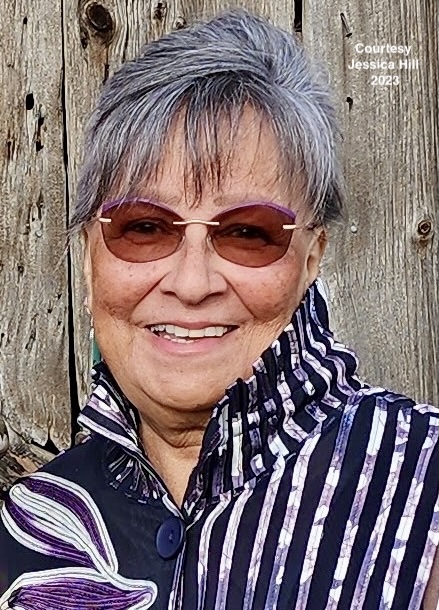
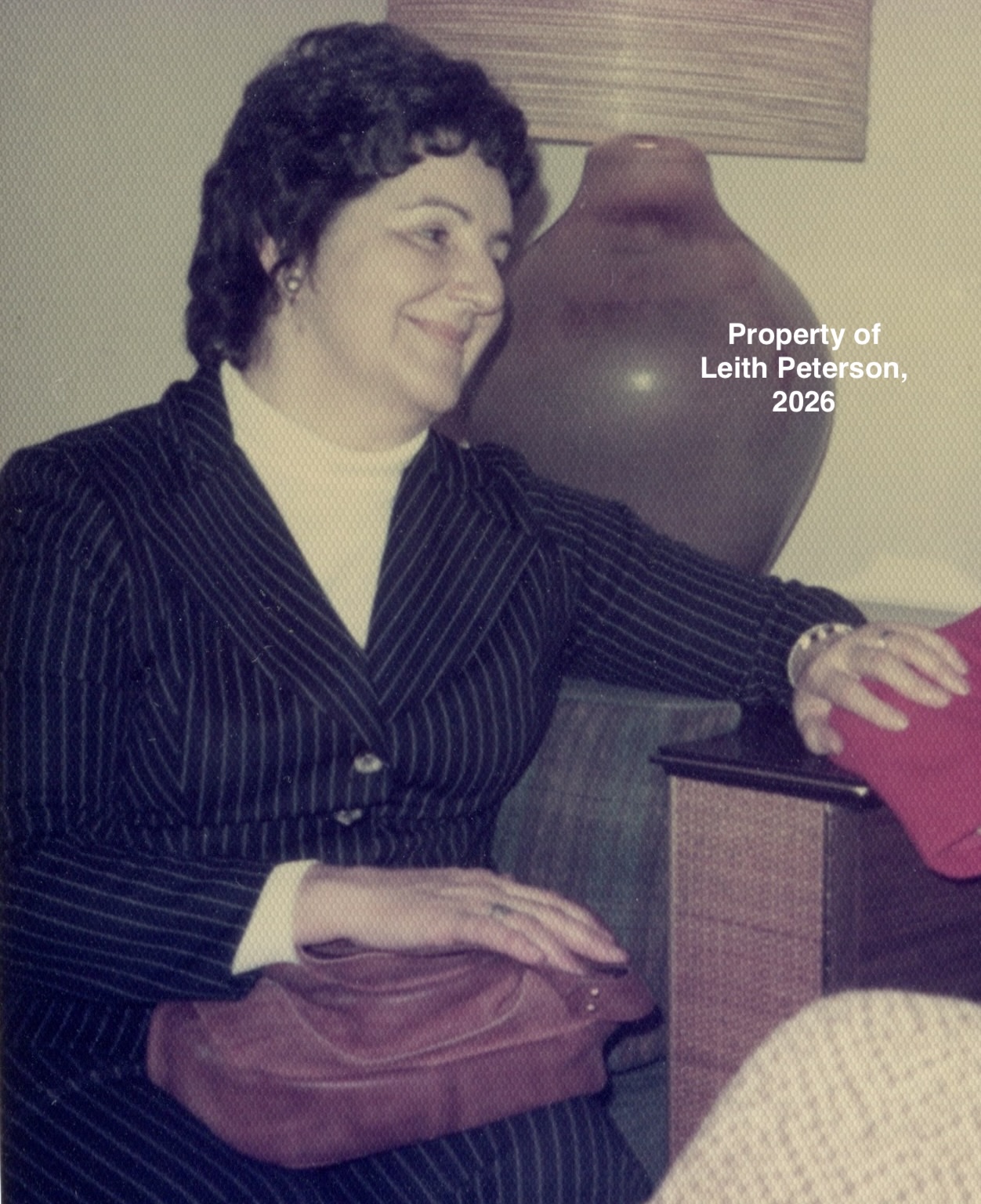
Since school did not go past elementary at Oneida, Jessica started attending Westminster High School in London in 1964 or 1965. My mother came to the school because she wanted to meet some artisans from Oneida. Somebody pointed her in Hill’s direction and the two got along right away. Hill agreed to introduce her to some people in her community.
Below is a photo of my mother that was taken around 1964:
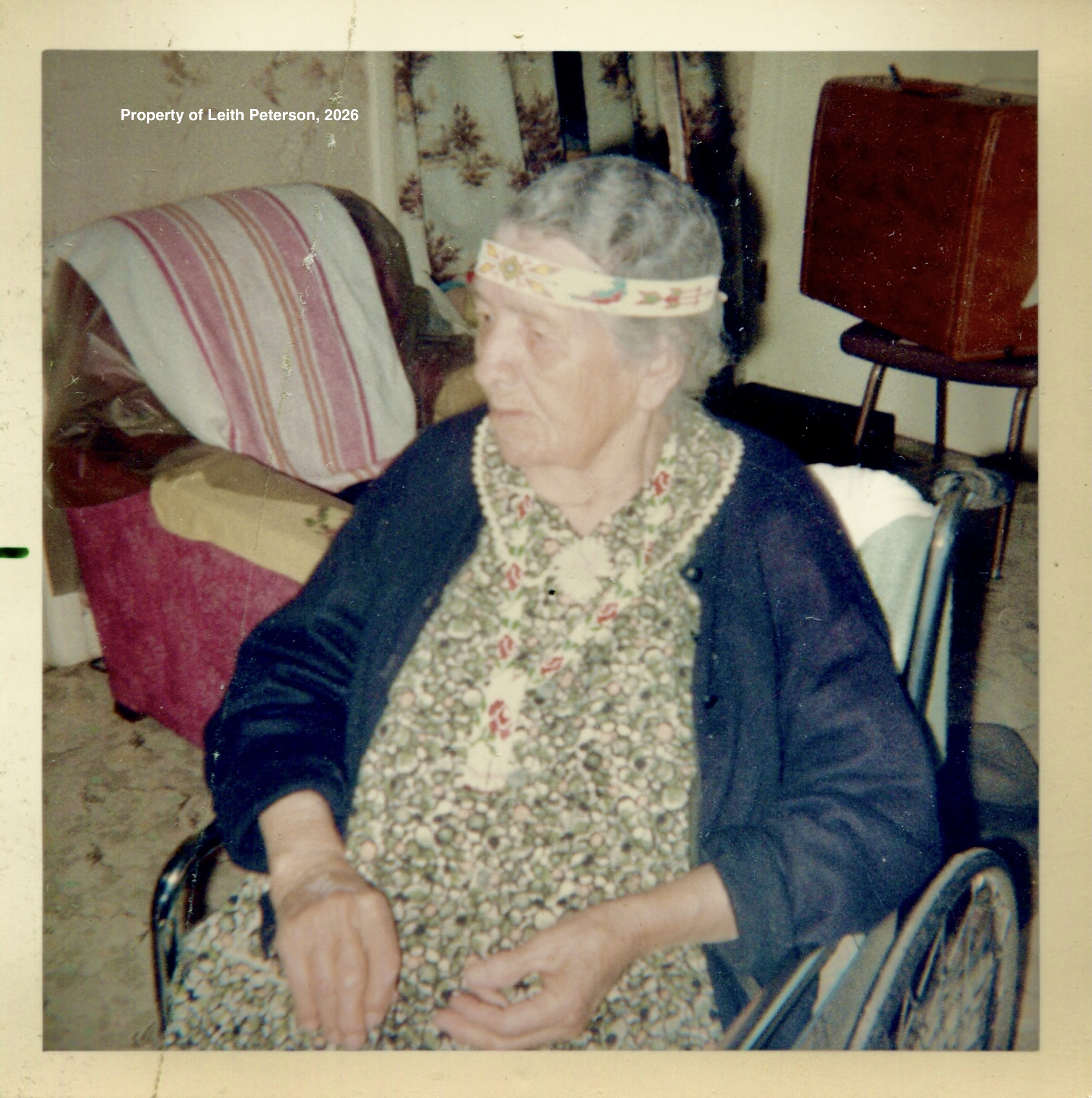
One of the first individuals my mother met was Hill’s great-aunt Mrs. Louisa Day. Day graduated from the Mount Elgin Residential School and spoke Oneida fluently. She was instrumental in initiating the annual Oneida fairs. She served on the fair’s board of directors and contributed to cooking there from morning to night. She passed away in 1967 at the age of 98. Below is a photo of Mrs. Day, which was probably taken around 1965:
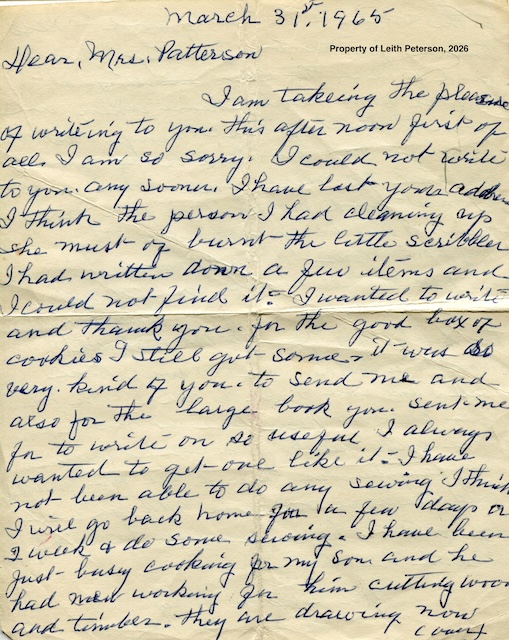
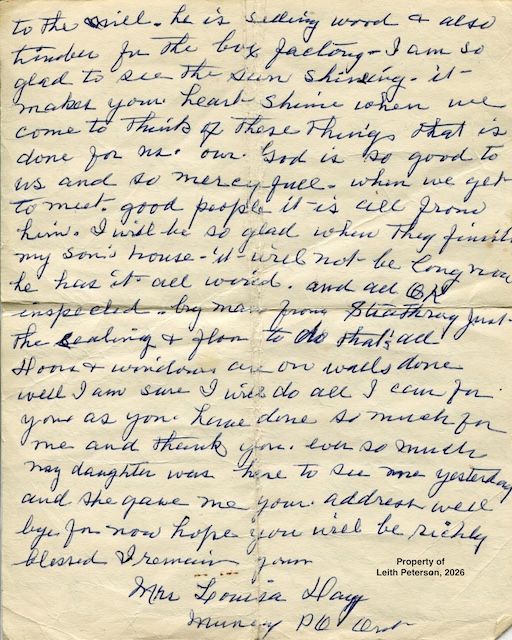
In March 1965, Mrs. Day wrote a two-page letter to my mother, thanking her for a box of cookies and a “large book” to write in. She also told my mother about cooking for her son who was finishing up his house and getting it wired. 1
In addition, my mother met Irvin Chrisjohn, his wife Eula and their son Darryl. This family did a lot of work with corn and corn husks.
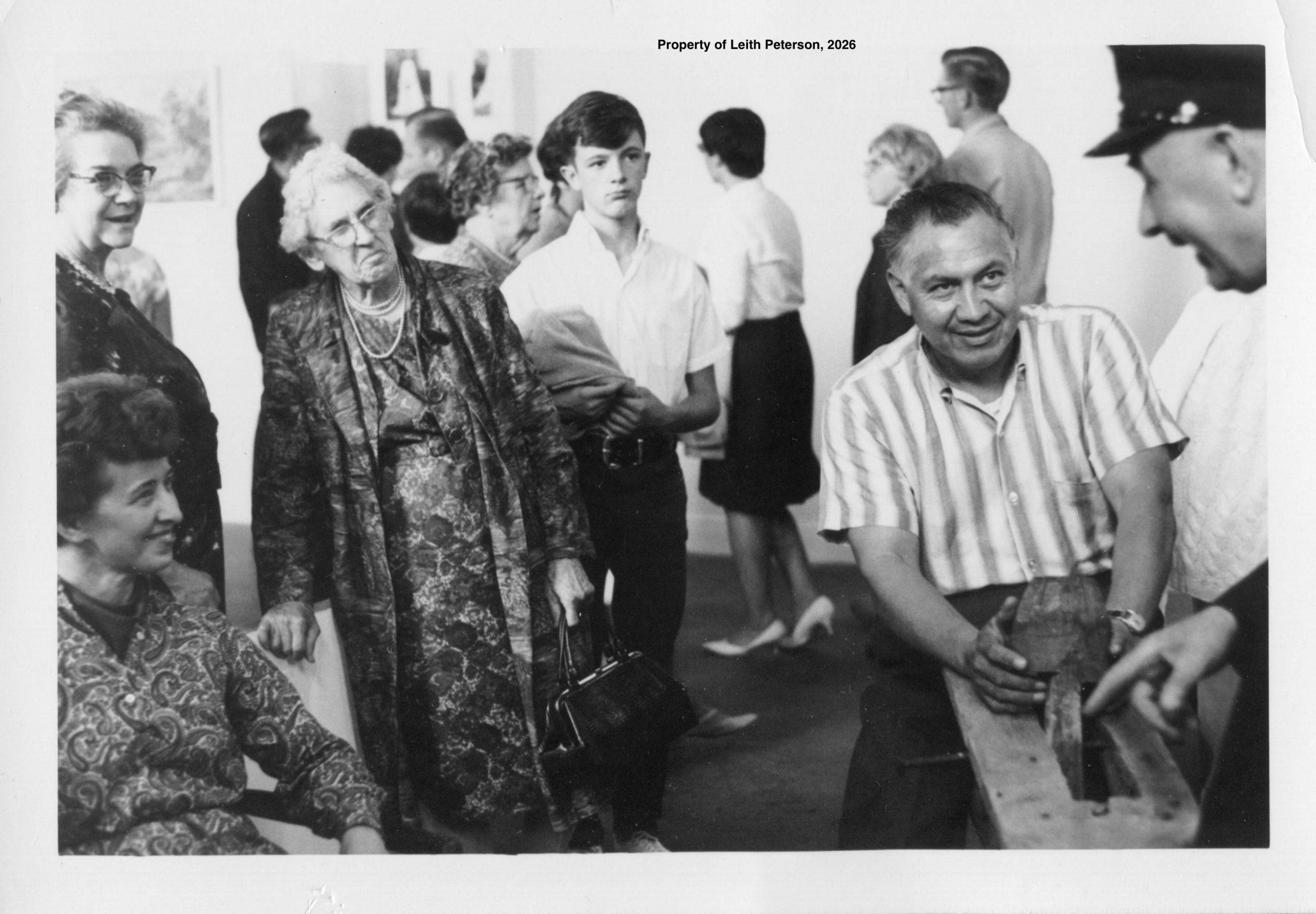
Below is a photo of Irvin, which was likely taken at the “Indians’ Display of Crafts.” This display was held at the Western Fair’s Confederation Building in September 1965. My mother was on the board of the Western Fair at the time, and helped organize this display, with assistance from the Citizenship Branch of the London Council of Women.
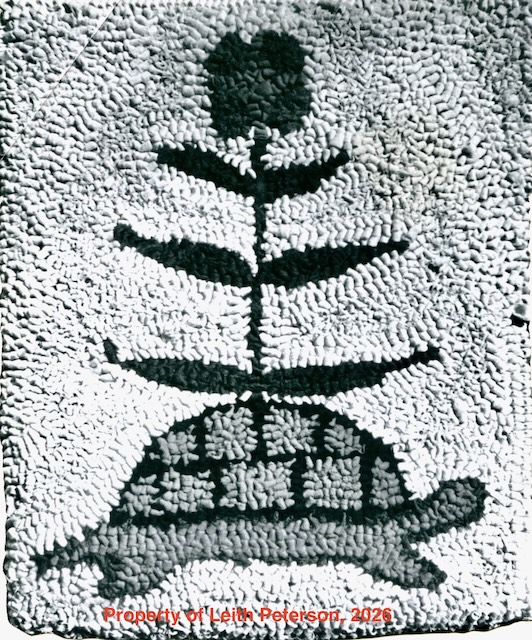
Irvin also created hooked rugs, such as this one with the Iroquois Creation Symbol.
Eula made this corn husk doll.
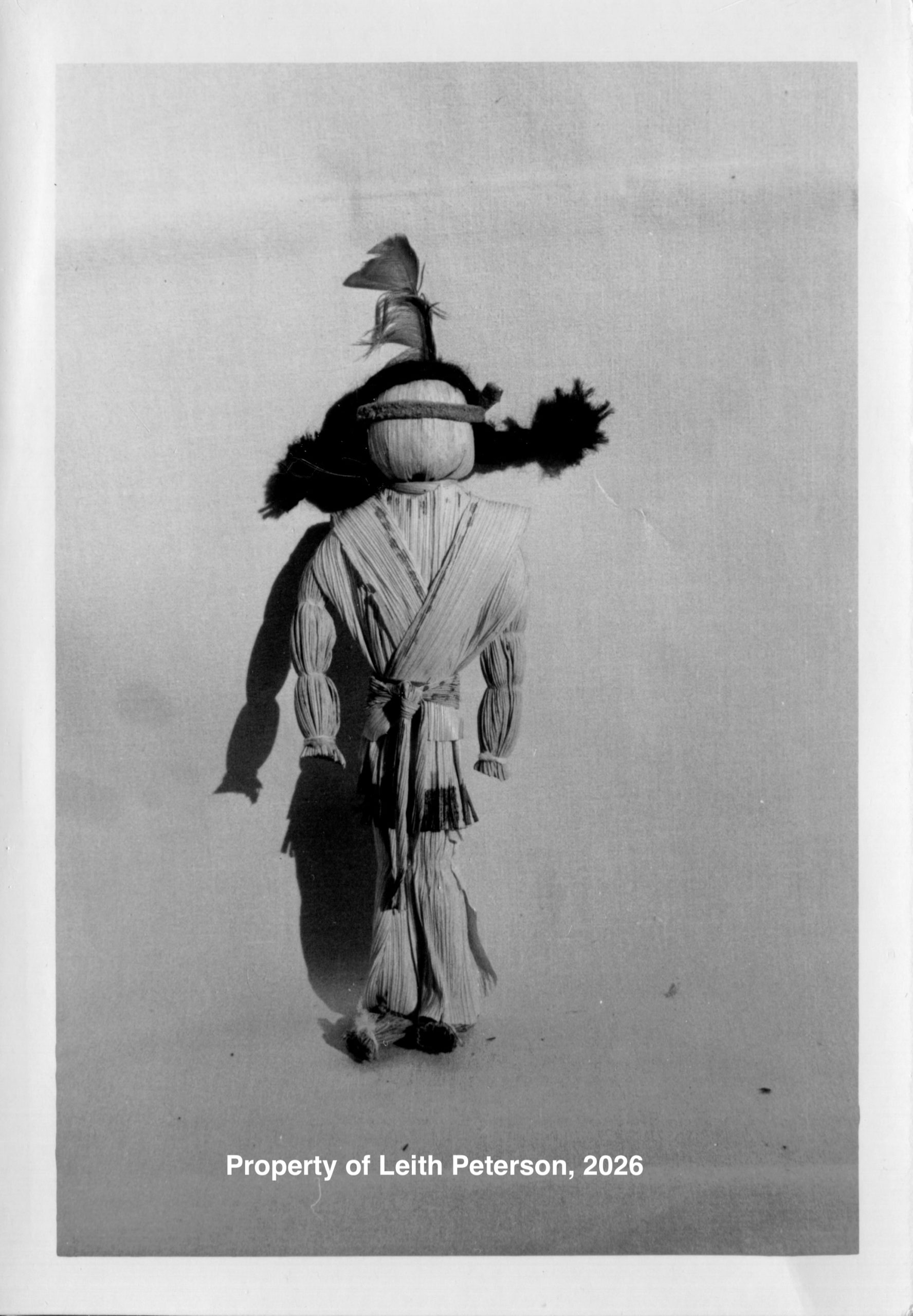
My mother brought the crafts she found at Oneida to town, sold the items and then returned with the money she had made to give to the artisans. She was fascinated by the Oneidas’ use of corn to make mats, dolls and decorative items, along with its importance as a food source. She appreciated the fact that every part of the corn was used for some purpose, including the husks.
But why would my mother, whose ancestry was primarily Scottish and English, be interested in learning more about craftspeople in a nearby Indigenous community?
According to a circa 1970 biography my father, Charles T. Peterson (1913-2007) put together about my mother, she thought Non-Indigenous Canadians like herself should be doing more to support Indigenous people who lived in rural areas because they did not have the same opportunities as their urban counterparts.
In one of her handwritten journals, she said that the “Anglo-Saxon atmosphere of pseudo-gentility” prevented individuals with “widely different opinions from having a conversation or dialogue.” The feeling was very strong that if people disagreed with each other, it was because of dislike, which could create “strong feelings of resentment.” She thought instead that Non-Indigenous people must strive to be “bridges, not walls” within their own culture and across “cultural gaps.”
My mother was specifically interested in promoting Indigenous crafts because she was an artist herself. From a very young age, she drew constantly, even in the letters she wrote to her parents. She also kept scrapbooks in which she penned clever images in the margins. Moreover, she did sculpture, macrame, fish netting–and mastered them all with great ease. So she understood intuitively it was worthwhile for Indigenous people to be engaged in the arts. I believe it was a combination of her belief in being a bridge between cultures and her strong interest in Indigenous ingenuity that drew her in.
Moreover, she had experience promoting artists and their careers. In 1965, when she was a director of the Western Fair, she commissioned marionette plays from University of Western Ontario English professor James Reaney (1926-2008) and London artist Greg Curnoe (1936-1992).
Her training as an art historian (Art History B.A., University of Rochester) meant she recognized the creative process was a continuum that was built upon and added to by successive generations and cultures. Her B.A. in Occupational Therapy from the University of Toronto (1943) taught her that solutions needed to be client centred.
Hill transferred from Westminster to Central High School in 1967. Because Central was across the street from our Peterson family home at 283 Dufferin Avenue near London’s downtown, she saw my mother more often. On one occasion, my mother taught her how to do tie-dye with wax.
Hill boarded at a house on Colborne Street. My mother and she would go to Oneida after school and then Mom would drop Hill off on Colborne.
Hill enjoyed going to my mother’s smorgasbord dinner parties because there was an interesting mix of people and Mom was a gourmet cook. Hill became adept at having a conversation while standing up and eating. Attending these parties also helped Hill to become more at ease around Non-Indigenous people.
When my mother was asked to coordinate the Indian (later called Native Studies) program at Fanshawe College in London, she knew it was essential for Native people to be involved with the curriculum. That was why she arranged for several guest lecturers, including Hill, to prepare and present course material. Irvin Chrisjohn also prepared and presented course material but on a different subject than Hill.
Hill went with my mother to Six Nations where she was introduced to Elda (Bun) Smith, who produced exceptionally fine Mohawk pottery. Below is a photo of Smith in her pottery studio. It was likely taken around the mid-1960s.
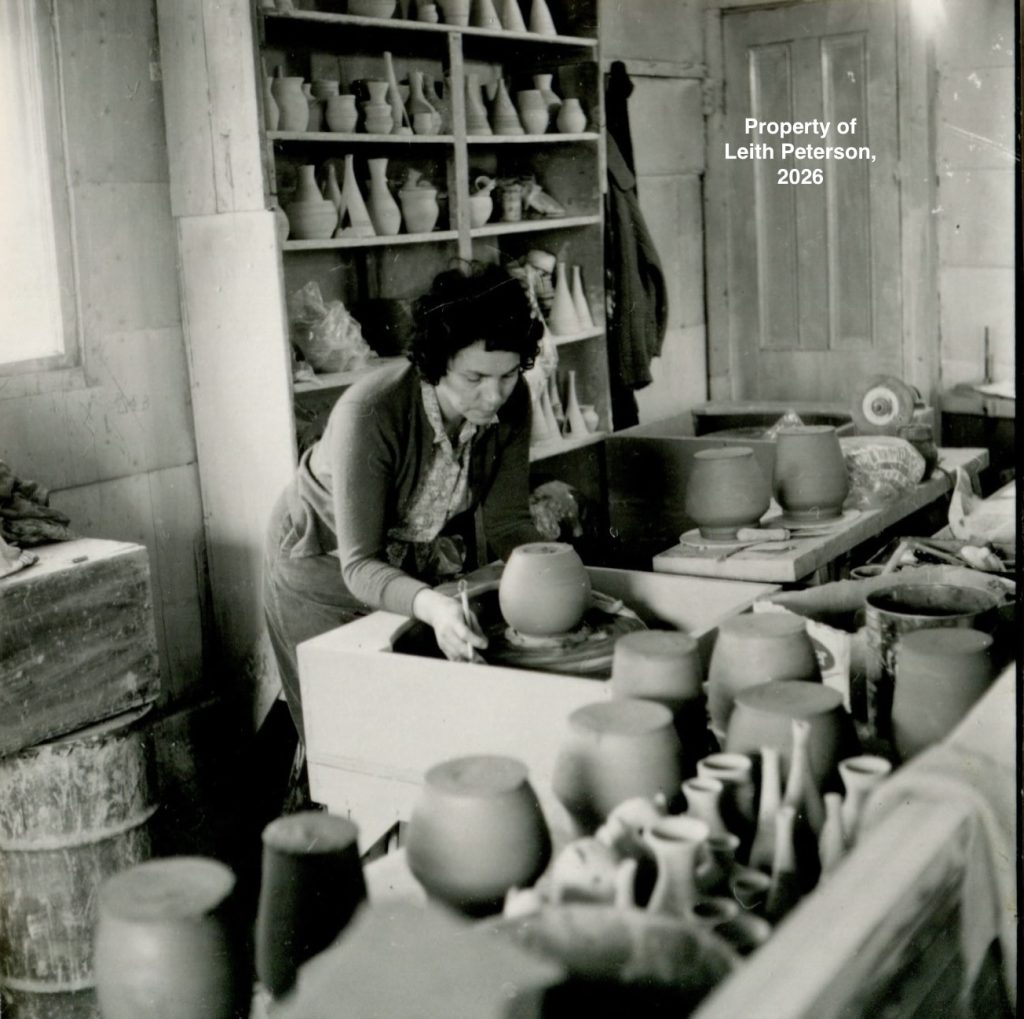
Jessica also met Joe and Florence Hill of Six Nations through my mother. Joe was a renowned Six Nations educator who received an honorary doctorate from the University of Western Ontario in 1970 and who was appointed as a member of the Order of Canada in 1973.
Joe and Florence said that my mother’s “great contribution to the Indian people has been her recognition of their “inate abilities and potential.” She has endeavoured to show that the “Indian people are an asset to the culture of this country and not a liability.” 2
At both Oneida and Six Nations, my mother learned about the Iroquois Creation Symbol and the White Roots of Peace.
Jessica said if she asked my mother something, my mother would follow through, which a lot of people would not have done She considered my mother to be like a “second mother.”
After graduating from Central, Hill worked as a summer student while she studied for her B.A. at the University of Western Ontario. She did research for Western academic Don Simpson’s PhD thesis entitled “Negroes in Ontario from early times to 1870s.” Hill stayed a Westminster College (the United Church of Canada residence on campus) during the 1969 summer. She got to know people from different countries with the Canadian University Students Overseas (CUSO) and the Canadian International Development Agency (CIDA). Simpson helped her secure a room with Doris Yebowa who was from Africa.
During her university years, Hill volunteered with the Native Peoples Resource Centre which at the time was in one of the Westminster College buildings. When she graduated with her B.A. in Sociology in 1972, she was the first woman from her community to do so. She then worked on a Department of Indian Affairs curriculum development grant at the Native Peoples Resource Centre for the summer.
A Master of Arts Degree in Education Leadership from Eastern Michigan University came next. In addition, she obtained certificates from Simon Fraser University in British Columbia and the Canadian Institute for Conflict Resolution at St. Paul’s University in Ottawa, Ontario. in 1996 she took an entrepreneurial course which led to her becoming a highly regarded small business owner and consultant.
Unfortunately, after Hill left London in the fall of 1972, my mother’s health started to deteriorate from an undiagnosed cancer. I was living outside of London–in Vancouver and then Yellowknife–for much of this period and only returned home in October 1976 when I learned my mother was terminally ill. This cancer eventually led to my mother’s passing in December 1976.
When Hill visited my mother’s grave at the Leith [Ontario] United Church cemetery in Leith, Ontario around 1977, she saw on the tombstone that my mother’s first name was Jessie. However Hill had always known my mother as Jay.
Below is a photo of my mother’s grave that I took at the Leith cemetery in June 2006.
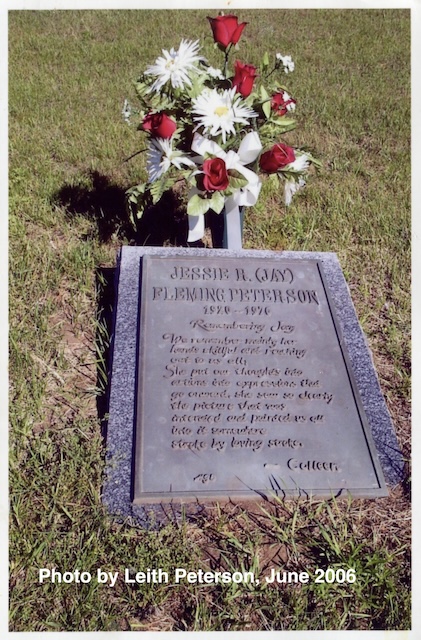
Although Hill’s legal name was Jessica, she was known as Jessie when she was growing up. She only reverted to Jessica when the Central High School administrators wanted her to go by her legal name.
Hill wanted to name her first born after my mother. But she thought it would create confusion if her daughter had the same name as she did.
She decided if my mother liked the name Leith and she called her daughter that, then she would name her daughter Leith too. Jessica’s daughter Leith was born in 1978, and lives in the Kahnawake Mohawk Territory, south of Montreal, with her family. in 2025, Jessica moved from Oneida to be closer to her daughter and other family members who live there, although she still retains a residence at Oneida.
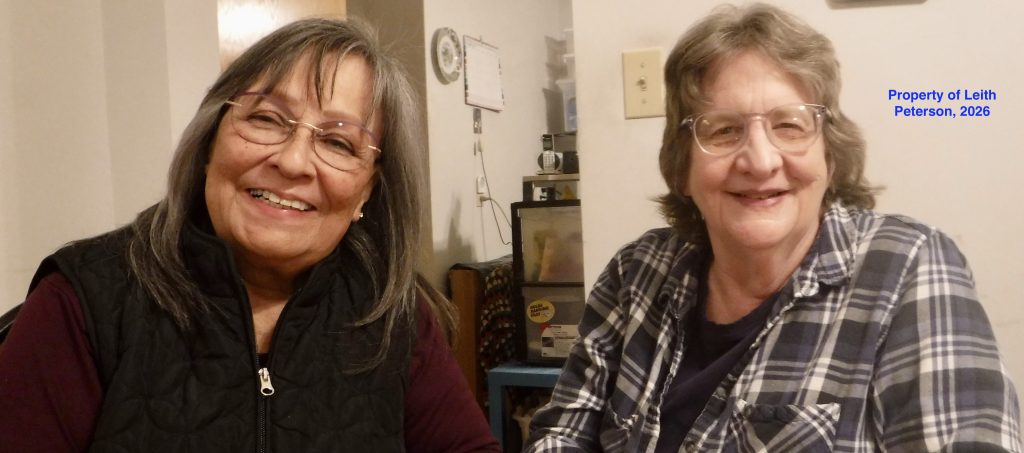
I certainly remembered Jessica as a friend of my mother’s, but I had been out of touch with her for many years. In the summer of 2022, we met at a Cross Cultural Learner Centre (CCLC) gathering in London, organized with the help of Don Simpson, the CCLC founder. Bryan Loucks, who was the former chair of the Native Peoples Resource Centre, also contributed to bringing this meeting about.
The photo below of Hill and me was taken when she visited me in January 2023.
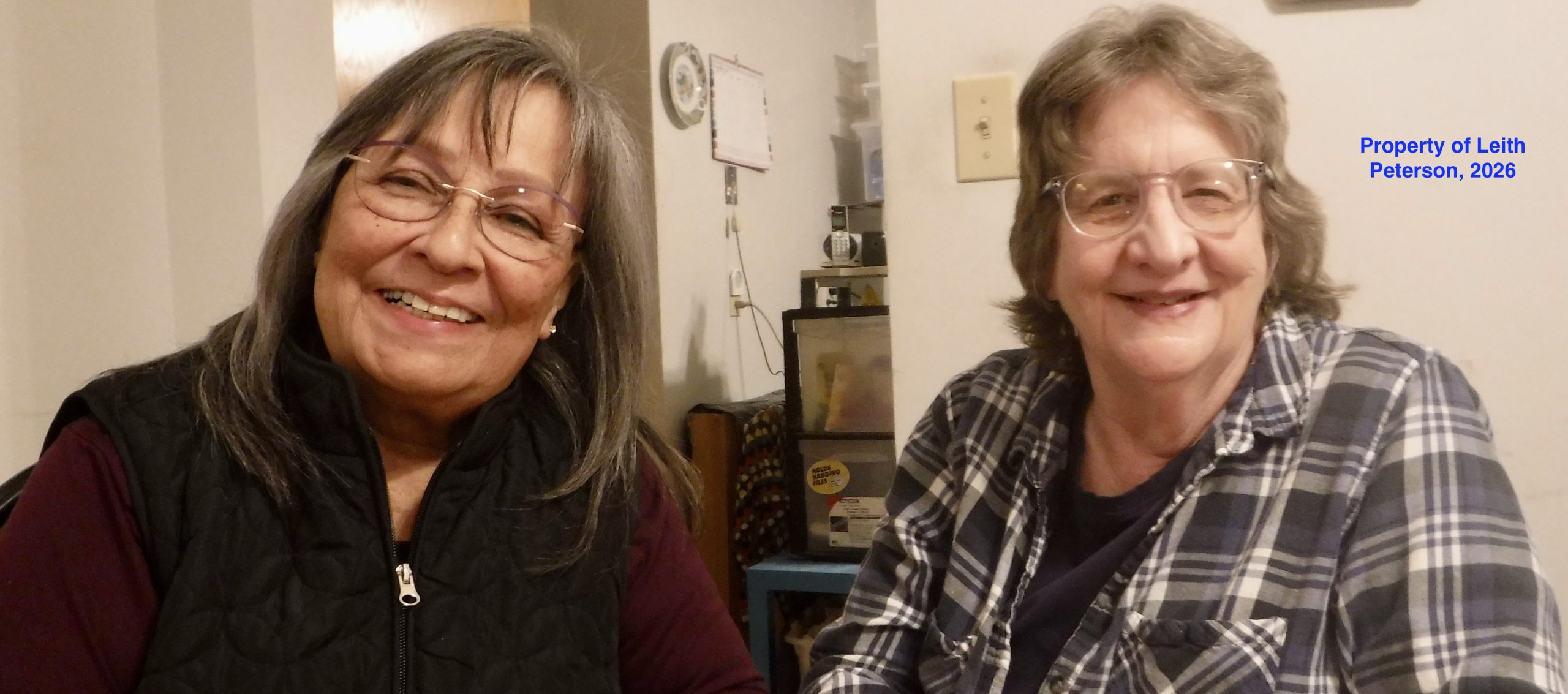
In 2023-2024, Hill’s daughter Leith Mahkewa was the Indigenous artist-in-residence at the University of Western Ontario here in London, Ontario. In May 2024, Mahkewa put on a fascinating exhibition at Western’s ArtLAB Gallery featuring a cradleboard she carved herself. She then inset beadwork on the back.
Below is a photo of Hill and her daughter Leith at the exhibit, with Leith’s stunning cradleboard adorned with beadwork.
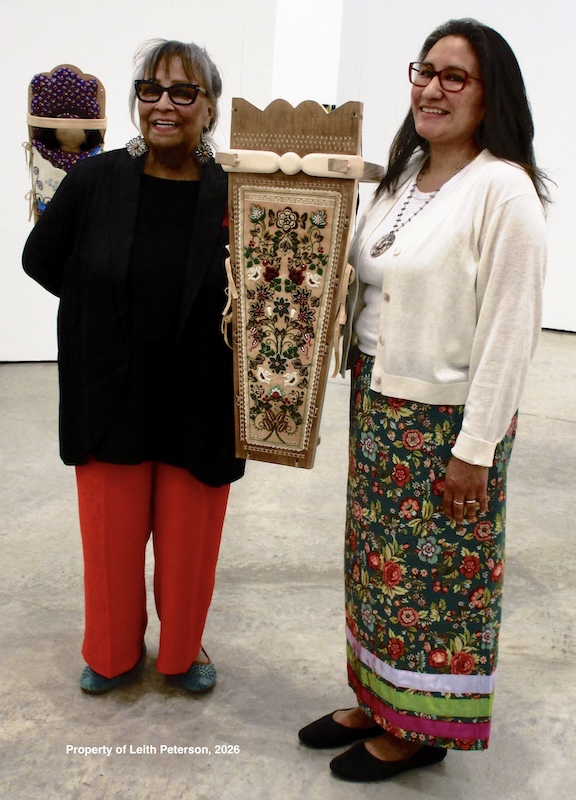
I very much enjoyed attending this exhibition and meeting Leith M for the first time. Here is a photo of the two Leiths at the exhibition.
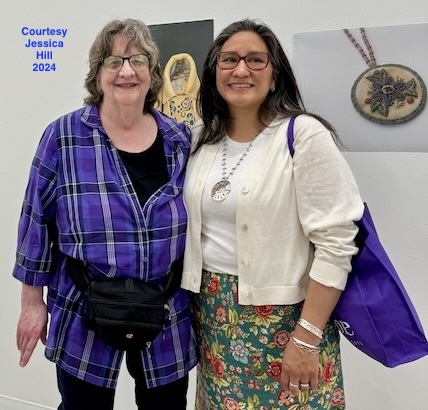
Leith M and Margaret host an enjoyable podcast called “The Beading Table” at Kahnawake. I’ve watched a couple of episodes and found them very interesting. The two not only exchange ideas about beading but also answer questions from viewers. In addition, they help each other to sort out the various challenges they are facing, as well as celebrate successes.
It has been good to reconnect with Hill after all these years, and to know she still treasures the time she spent with my mother. I am also happy that Hill’s daughter Leith is such a talented artist, who is keeping the beading tradition alive among the Haudenosaunee.
1 Mrs. Louisa Day called my mother “Mrs. Patterson” in her 1965 letter because she thought my mother’s last name was that. But it was Peterson.
2 My father’s circa 1970 biographical sketch of my mother included this quotation from Joe and Florence Hill. His sketch is unpublished.
Bibliography
Bronson, L.N. ([ca. 1967]). Mrs. Louisa Day at 98: Oneidas’ link with the past. London Free Press.
Peterson, C.T. ([ca. 1970]). Peterson, Jessie Royce Fleming – “Jay Peterson” [Unpublished manuscript].
Peterson, L. (2003, May 10). Remembering Mom. London Free Press, p. F3.
Sallaway, P. (1972, May). Jessica first Oneida woman to receive degree from UWO. London Free Press.